
A while ago, I posted an article about the 19th and early 20th century quest to derive mathematics from the principles of formal logic. We kicked off with Peano arithmetic, which built natural numbers from two ad-hoc constructs: an element representing zero and an abstract “successor” function S(…).
Later, we leaned on set theory to encode the underlying structure of these symbols with more precision. This netted us a hierarchy of set-theoretic natural numbers known as ordinals. It also led to an interesting insight: if we allowed the existence of infinite sets, then the set of all natural numbers (ℕ) itself had the structure of an ordinal. In the article, we labeled this infinite number ω and demonstrated that it could be manipulated using the same arithmetic rules as finite numbers, but that it sometimes behaved in wacky ways. For example, we established that ω + 1 ≠ 1 + ω.
We also touched on various methods of reasoning about the magnitude of ordinals and showed that these approaches diverge from each other in the realm of infinities. In particular, we talked about Georg Cantor’s notion of cardinality, which put many distinct infinite ordinals in the same size class, but indicated that there’s a fundamental difference in scale between the set of natural numbers and the set of reals (ℝ).
If you haven’t read the article but are intrigued, I strongly encourage you to give it a go (link). I think it’s an excellent and accessible introduction. If you’re up to speed, there might be one thing that’s bugging you: we carefully defined natural numbers from first principles, but then pulled reals out of a hat. This is a gap worth addressing, because as it turns out, real numbers are profoundly weird.
Natural numbers (ℕ)
As a reminder, in the earlier article, we constructed a succession of labels that corresponded to subsequent natural numbers by conjuring an object representing zero and then successively applying function S(…) to it:
The “:=” operator means “is defined as”. Elsewhere, you might see this written as ≝, ≜, or a regular =.
In Peano arithmetic, the label “0” and the successor function S(…) have no deeper meaning: they are just “things” with a couple of common-sense properties spelled out. All the notation indicates is that every subsequent object has some fixed relationship to the one that came before. In the set-theoretic approach we switched to later, we fleshed out the internal structure of these objects a bit more, but for the purpose of this article, we don’t need to cross that bridge.
The important point is that the successor relationship allowed us to define the behavior of the “+” operator using a pair of simple substitution rules:
Although the rules may seem cryptic, they effectively just codify that adding zero is a no-op and that a + (b + 1) is the same as as (a + b) + 1. This simple ruleset is enough to solve problems such as 2 + 2 without any assumptions about the fundamental meaning of “2” or “+”.
To illustrate, from the definition of Peano numbers, note that “2” is the same as S(1), so 2 + 2 can be restated as 2 + S(1). Switching to that form allows us to apply rule #2, in turn rewriting 2 + S(1) as S(2 + 1):
After that, we can apply the same steps again to expand the nested 2 + 1 sum:
We now have a doubly-nested sum involving zero, so we can apply rule #1, getting rid of the sum (2 + 0 = 2) and “unwinding” the successor functions to arrive at the result:
Again, if you’re interested in a more detailed walkthrough, including C code that explains the process in programmer-friendly terms, check out the article linked earlier on.
What we haven’t covered in that article is that we can use a similar approach to recursively define multiplication for naturals:
In effect, without having to explicitly define subtraction for the set-theoretic members of ℕ, we’re saying that a · b can be rewritten as a · (b-1) + a. This process can be continued until we get to a · 0; at that point, the multiplication part works out to zero, so we just unwind the stack and gather all the “+ a” terms. For example, here’s the process to calculate 5 · 3:
This will come in handy in a while.
Integers (ℤ)
A major hurdle on our path toward a complete system of arithmetic is that natural numbers can’t represent negative values. This means that if we attempt to define subtraction, many results will not have an in-system representation, throwing a wrench in the works.
To extend ℕ to negative numbers, we could futz around with a way to encode the minus sign and then special-case it in the arithmetic rulesets. That said, a more “regular” approach is to define integers as a separate hierarchy of numbers, each integer z consisting of an ordered pair of naturals: z = (a, b). The first element of the pair represents the positive component while the second represents the negative part. Thus, integer +5 can be encoded as (5, 0) while integer -5 becomes (0, 5).
You might be wondering if we just pulled the concept of an “ordered pair” out of thin air. Yes and no: it’s new here, but in set theory, these pairs are mapped to normal sets, except we design the mapping so that (a, b) differs from (b, a). This can be done in a number of ways, but a common approach devised by Kazimierz Kuratowski is:
In essence, the pair is represented by a two-element set, but the second element also embeds a copy of the first, so the result is different depending on the order of the elements in the pair. This encoding has a couple of nice properties, but we’re not going to rely on any of them.
To define the addition of pair-based integers, we can simply add the “positive” and “negative” halves separately. Since the underlying elements are natural numbers, we already know how to sum them, and we can write:
In the same vein, because each integer effectively expresses the difference between two underlying numbers, the result of multiplying two integers (a, b) and (c, d) will follow the school-taught pattern of (a - b) · (c - d) = ac - ad - bc + bd. We split out the positive and negative parts of the solution and write:
These rules sort of work. For example, adding integer +5 and -5 nets us:
The result (5, 5) seems to be saying “zero”, but it’s different from other zero-like results, such as (1, 1) or (0, 0). To make the system usable, we need to codify that pairs (a, b) and (c, d) represent the same integer if a - b = c - d.
We haven’t defined the subtraction operator for set-theoretic naturals that make up the integer pairs, but we can shuffle the terms of the “sameness” criterion to express the same principle in terms of addition, which we know how to do:
With this pair equivalence relationship defined, we assign integer labels such as “+5” not to a specific pair, but to an entire equivalence class: a collection of ordered pairs that satisfy the above criteria. In this view, our new hierarchy of numbers looks the following way:
We’re mostly done with integers, but before we wrap up, let’s ponder if the set of integers is “larger” than the set of natural numbers. By some metrics, you could argue it is. That said, using the method outlined in the earlier article, there’s at least one way to map every integer to a natural number without the risk of running out of naturals:
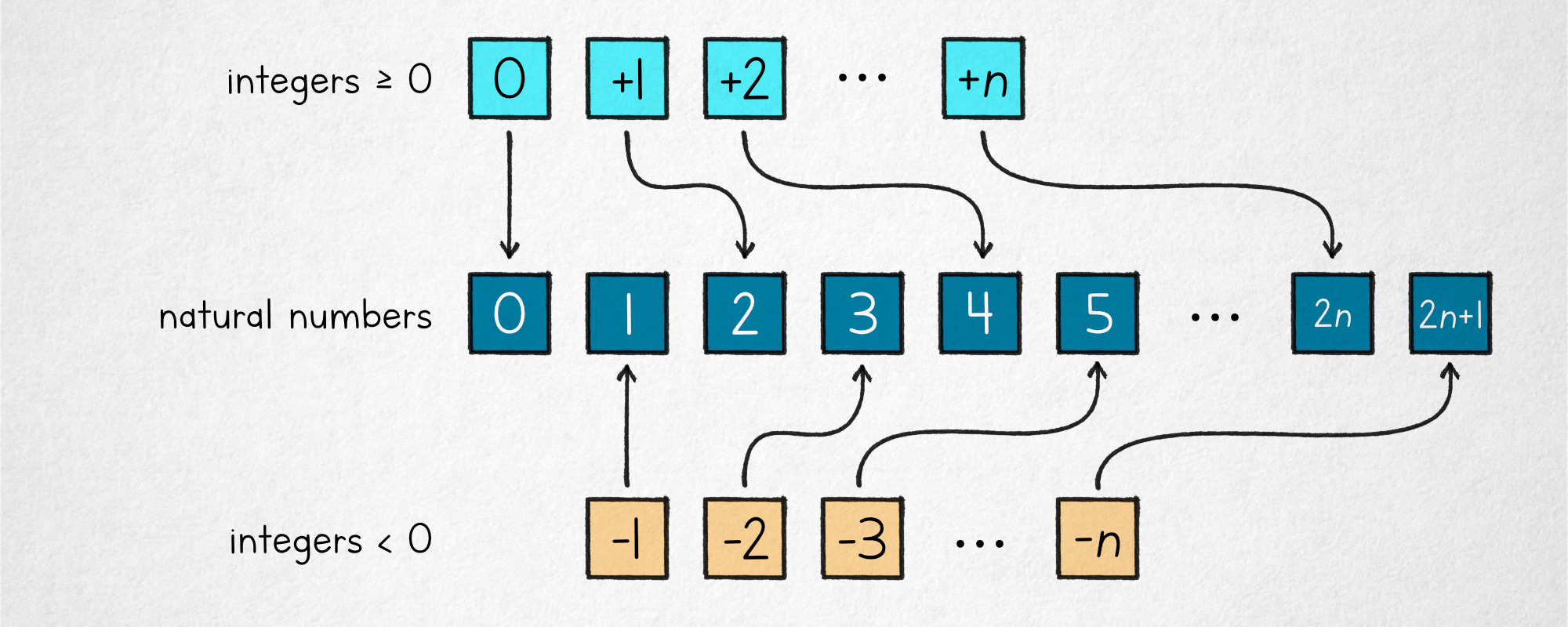
This works because every element in these sets is finite but there is no upper bound; for any finite +n, the number 2n is also finite and has a place in ℕ. The existence of a one-to-one mapping implies that the sets have the same cardinality.
Rationals (ℚ)
Rational numbers are values that can be expressed as a ratio of two integers: a / b. In the previous section, we defined each integer as an ordered pair of naturals that effectively encodes subtraction. So, here’s the neat part: nothing stops us from taking two integers and fashioning them into another, higher-level pair that encodes division. From these integer pairs, we obtain a hierarchy of rational numbers: q = (a, b).
In this view, we consider rationals (a, b) and (c, d) to be equivalent if the underlying integers satisfy the criterion a / b = c / d (for a non-zero b and d). Once again, we don’t have the division operator defined for the underlying integer values, but we know how to multiply them, so we can restate the rule the following way:
This nets us the following taxonomy:
The multiplication rule for two pairs representing rational numbers can be defined as a trivial restatement of a/b · c/d = ac/(bd):
The addition of rationals is formalized in an equally straightforward way, following the normal a/b + c/d = (ad + cb) / (bd) pattern:
What’s the “size” of the set of all rational numbers? Well, again, depends on how we look at it, but we can show that the cardinality of is not greater than ℕ. One visual approach is to construct a two-dimensional array of fractions in the form of x/y:
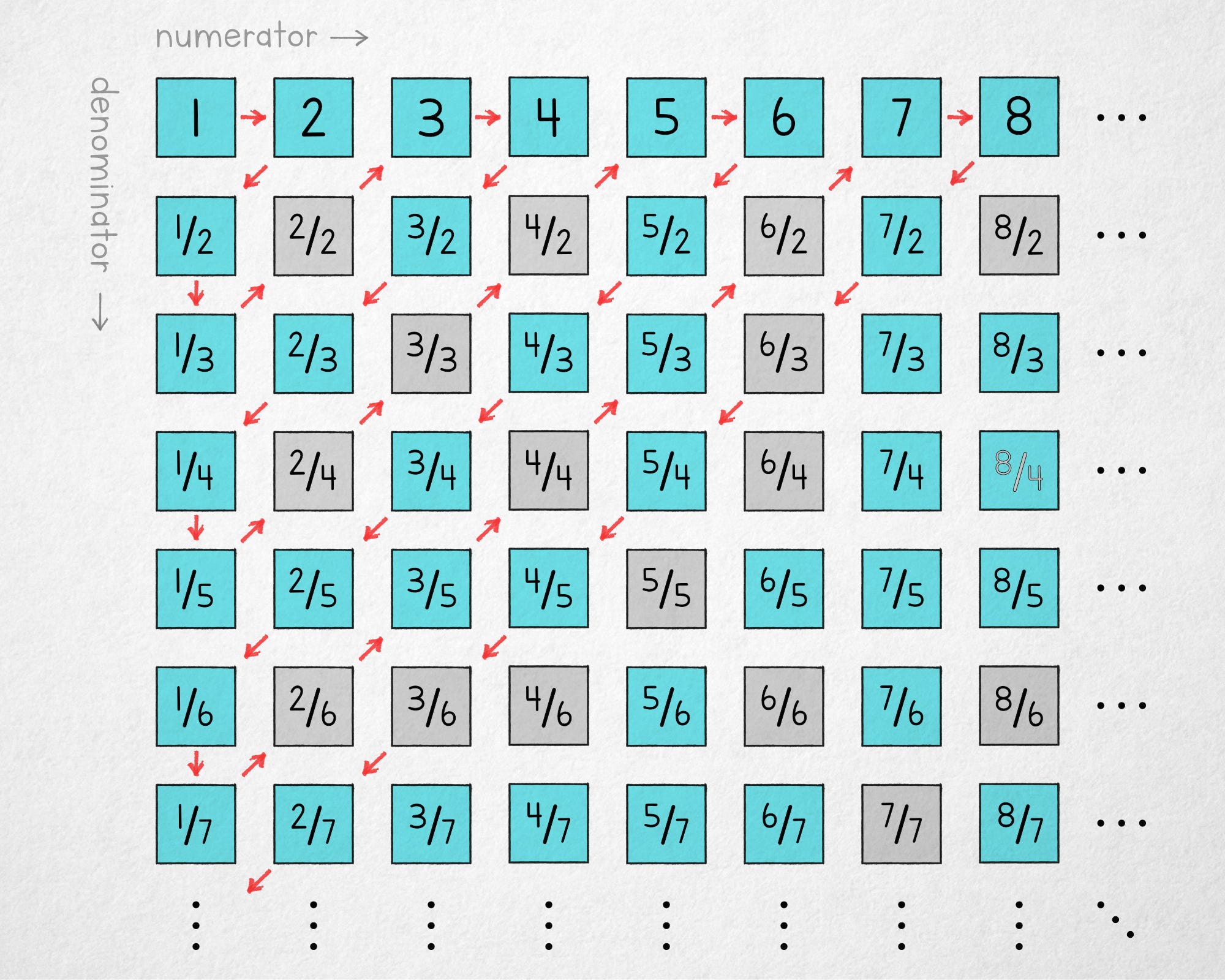
It should be evident that because x and y coordinates separately move through every possible natural number, the array contains all positive rational fractions. Some of the tiles are redundant (e.g., 2 is the same as 4/2), but this overcount doesn’t matter for the proof.
With the rationals laid out, we can traverse this grid in a way that lets us assign every tile to an integer without leaving any gaps and without ever running out of members of ℕ. The start of one such traversal pattern is indicated by arrows in the figure. We begin in the top left corner (1), move one tile to the right (2), take a sharp turn to the right and start moving diagonally until we hit the vertical edge (½), move one tile down (⅓), then follow a diagonal pattern back (toward 3). Rinse, repeat. By analogy to what we’ve done for integers, the result doesn’t change if we toss negative rationals into the mix.
Computable numbers
Not every number can be expressed as a ratio of two integers. The two examples of irrational numbers that every reader should be familiar with are √2, which can be expressed in polynomial terms, and π, which cannot.
Although these numbers can’t be represented as rationals, they can be explained in terms of an algorithm you need to follow to approximate them to an arbitrary degree. For example, the sum of the following terms starting at n = 0 will slowly but surely converge to π as the count of summed elements grows:
Within the bounds of the precision of floating-point numbers, you can observe the behavior by running the following C code (demo link):
#include <stdio.h>
#include <stdint.h>

int main() {
  double sum = 0;
  for (uint64_t n = 0, pos = 0; n <= 65536; n++) {
    sum += 8.0 / ((4*n + 1) * (4*n + 3));
    if (n >> pos) { printf("[%5ld] %.05f\n", n, sum); pos++; }
  }
}
At first blush, it would appear that any well-specified irrational number of our choice can be expressed as an approximation algorithm. This leads to a concept that should appeal to any geek: computable numbers. It’s the set of all numbers that can be approximated to an arbitrary precision in finite time by a theoretical model of a computer known as a Turing machine. In effect, the number is the algorithm.
Interestingly, the cardinality of the set of computable numbers is still the same as the cardinality of ℕ. An intuitive explanation is that there are only as many computable numbers as there are Turing machines that could generate them. The ruleset of every Turing machine can be encoded as a finite natural number — you could just write it down and then convert the spec to ASCII values — so we’re still in the realm of countable infinities.
Reals (ℝ)
Of course, we don’t teach about computable numbers in school. Instead, the most common “upgrade” from ℚ are reals: an idealized continuum on which, to put it in a hand-wavy way, every number exists whether we know how to algorithmically approximate it or not.
Of course, my phrasing here is severely deficient. It’s not a free-for-all: 🥔 (a potato) is not a real number, and to avoid a variety of complications, neither is √-1. The set ℝ extends ℚ, but it does so only in the immediate vicinity of rationals. Pick any real and there ought to be a rational fraction that’s arbitrarily close.
To describe the underlying structure of real numbers in more precise terms, we can turn to Dedekind cuts. Informally, the idea is that we can unambiguously identify each real number by associating it with the set of all rationals that come before it. More specifically, to describe real number x, we could take the ordered set of rational numbers and partition it into an ordered pair of sets (A, B), such that set A contains every rational q < x and set B contains every q ≥ x.
This description may seem circular: to build the representation of a real number x, we need to know where to make the cut, which seem to require some prior knowledge about how x relates to ℚ. That said, the point isn’t that our method lets us hone in on the exact location of π; it’s that the universe of real numbers is built by taking every possible Dedekind cut of ℚ. Some of these cuts coincide with rational numbers and some fill the gaps in between. In all cases, the numbers are the cuts, and π is somewhere out there — even if we can’t point to a specific rational number immediately precedes or follows it.
It’s worth noting that many irrational partitions can be described without knowing the exact “insertion point”. For example, to characterize the cut associated with ∛5, we can just say that set A consists of every rational q such that q³ < 5 and set B contains every q such that q³ ≥ 5. We can do math with that. That said, once more, the existence of a real number doesn’t hinge on the ability to construct a description like that.
Once we have numbers expressed in terms of Dedekind cuts, we can define arithmetic operations on reals in a pretty straightforward way. For example, to add set-theoretic real (A, B) to (C, D), we construct a new number (E, F) such that for every possible rational a selected from A and every rational c selected from C, the sum a + c is placed in E. In the same vein, for every b in B and d in D, the sum b + d goes into F.
I’ll spare you the abstract set notation, but as a practical example, if (A, B) represents 2 and (C, D) represents 3, we know that every a selected from A will be less than 2 and every c chosen from C will be less than 3. Therefore, every a + c value placed in E will be less than 5. Similarly, every b + d that goes into F will be greater or equal than 5. The resulting pair (E, F) is therefore the same as the cut representing the number 5.
We now have a continuum that contains numbers that are allowed to exist regardless of whether they can be described by an effective, finite procedure. As an unexpected consequence, the cardinality of ℝ is higher than ℕ.
We explored this property in the earlier article, but to briefly recap the argument, assume the existence of some 1-to-1 mapping between integers and all possible infinite decimal sequences representing reals between 0 and 1. The specifics of the mapping don’t concern us; we’re just asserting that it exists:
For every entry in the mapping, I underlined a successive decimal position on the real side. Equipped with this information, we can imagine a new infinite decimal built by looking at each of the underlined digits and then placing a different digit in the corresponding position of the newly-constructed value.
By construction, our new number necessarily differs by at least one digit from every assigned real. The presence of a member of ℝ that isn’t assigned to an integer is a contradiction that tells us that the postulated 1-to-1 mapping can’t exist, even just for the interval of (0, 1). There is a fundamentally higher “number” of reals than naturals — an uncountable infinity.
So what?
Well… from the earlier discussion, recall that the cardinality of computable numbers was the same as the cardinality of ℕ. The cardinality of ℝ — the “magnitude” of the set of reals — is fundamentally greater than that. In other words, we can assert that most reals are uncomputable.
But what would be a “tangible” example of an uncomputable real? That’s a good question! One possibility is any number that encodes the solution to the halting problem. It would lead to a paradox to have a computer program that allows us to decide, in the general case, whether some other computer algorithm halts. So, if a procedure to approximate a particular real amounts to successively solving the halting problem for all possible programs, and then putting the answer key in the digits of the real, we simply can’t have a computer implementation of that.
If you’re interested in a more general exploration of computability, check out my earlier article on busy beavers and the limits of algorithmic knowledge. But to cut to the chase, there are people who believe that the universe is functionally a computer — that is, that its rules are deterministic and can be simulated by a Turing machine. If so, that would imply that uncomputable numbers can’t be zeroed in on by any finite-time physical process, including human thought. They would be truly out of reach… and again, this would apply to almost every member of ℝ.
Cue the Twilight Zone theme music — and see you in a bit.
Further reading in the series:

And if you’re interested, the following post is notionally about logic, but it also talks about another way to define reals:

I write well-researched, original articles about geek culture, electronic circuit design, algorithms, and more. If you like the content, please subscribe.
Some postscripts:
1) Another interesting way to rephrase it is that a single real number can contain an infinite amount of information. In contrast, other numbers discussed in this chapter can only encode finite amounts.
2) You might also encounter an alternative way to define reals using Cauchy sequences. In essence, we define ℝ in terms of converging sequences of rational numbers that get arbitrarily close to any real (and in the limit at infinity, point to the real *exactly*). As with Dedekind cuts, we're not saying how each of these sequences looks like, just that every real number is a converging sequence of rationals. Both of these methods are functionally equivalent; if you're interested in rational approximations of reals, you might get a kick out of this article: https://lcamtuf.substack.com/p/approximation-game
3) In the first article in the series (https://lcamtuf.substack.com/p/09999-1), we asserted that reals follow the Archimedean property, i.e., they don't include infinitesimals. In standard mathematical education, this is a consequence of an ad-hoc axiom of completeness, but it also follows pretty naturally from the construction outlined in the article. Every integer is finite. If so, the stepover between rational numbers can be arbitrarily small, but it's always strictly larger than any conceivable notion of an infinitesimal (ε = "1/∞"). Every distinct real is a distinct partition of ℚ; the distance between partitions made for x and x+ε is smaller than the spacing of rational numbers, so such partitions would be indistinguishable and thus, would boil down to the same real.
4) In the same article, I introduced hyperreals without explaining their construction in a rigorous way. Hyperreals extend reals by adding infinitesimal and infinite quantities. There are several ways to approach this task, but one is to express infinitesimals as sequences of real numbers that converge to zero at different rates (and infinite values as the inverse).
I got a D in analysis. I can believe that 0 = {} but I had a hard time believing 1 = { 0, {}}. I can see how a Dedekind cut defines numbers but thats all a x b to me is not really {a-lower, a-upper} x {b-l, b-u}. Really the LUB was nonsense to me except for one thing, .9999... = 1.
Cardinality, ordinality and measure are what we have in the real world. I do believe there are irrational, transcendent, uncomputable and other numbers. Hyper reals, not sure, its just epsilon to me.
"Some of the tiles are redundant (e.g., 2 is the same as 4/2), but this is not important for the proof" there is therefore not an exact matchup on diagnolization of Q.
The professor said series do not equal sequences when I asked why can't you use the series test on a sequence. Isn't that what category theory is for.
Then there was how a differential equation is not a difference equation,
One Graduate student said quantum theory is not commutative and another professor said it was.
I also don't get Tropical analysis, the Collatz conjecture, modular forms and many other things.