
Perhaps the most famous equation in pop mathematics is Euler’s identity:
The equation is deemed profound because it combines not one, not two, but five “special” mathematical constants: e, π, 0, 1, and the imaginary unit i.
The identity is a special case of an equation known as Euler’s formula:
The identity form is what you get if you choose an angle of α = π in radians (180°). This makes the cosine expression equal to -1 and the sine part equal to zero, so the final result of the substitution is:
Now, four “special” values is still weak sauce, so we move -1 to the left to increase the profoundness factor by another 25%.
There are multiple “easy” proofs of Euler’s formula you can find on YouTube, but they all involve sleight of hand: they make unobvious assertions about infinite series and function derivatives, or rely on a circular definition of complex numbers. I don’t have a proof that will fit on a napkin, but I think there’s a reasonably intuitive way to reason about what the equation does.
A geometric view of complex numbers
Imagine a point in a Cartesian coordinate system that lies on the horizontal axis at a distance l from the center. If you wish to rotate this point by an angle α in radians, you can calculate the new (x, y) coordinates using simple trigonometry:
Less obviously, there is also a way to rotate points without trigonometric functions. If we take point (x, y) and flip the signs of the individual coordinates — (-x, -y) — we always achieve what looks like a rotation by 180°:
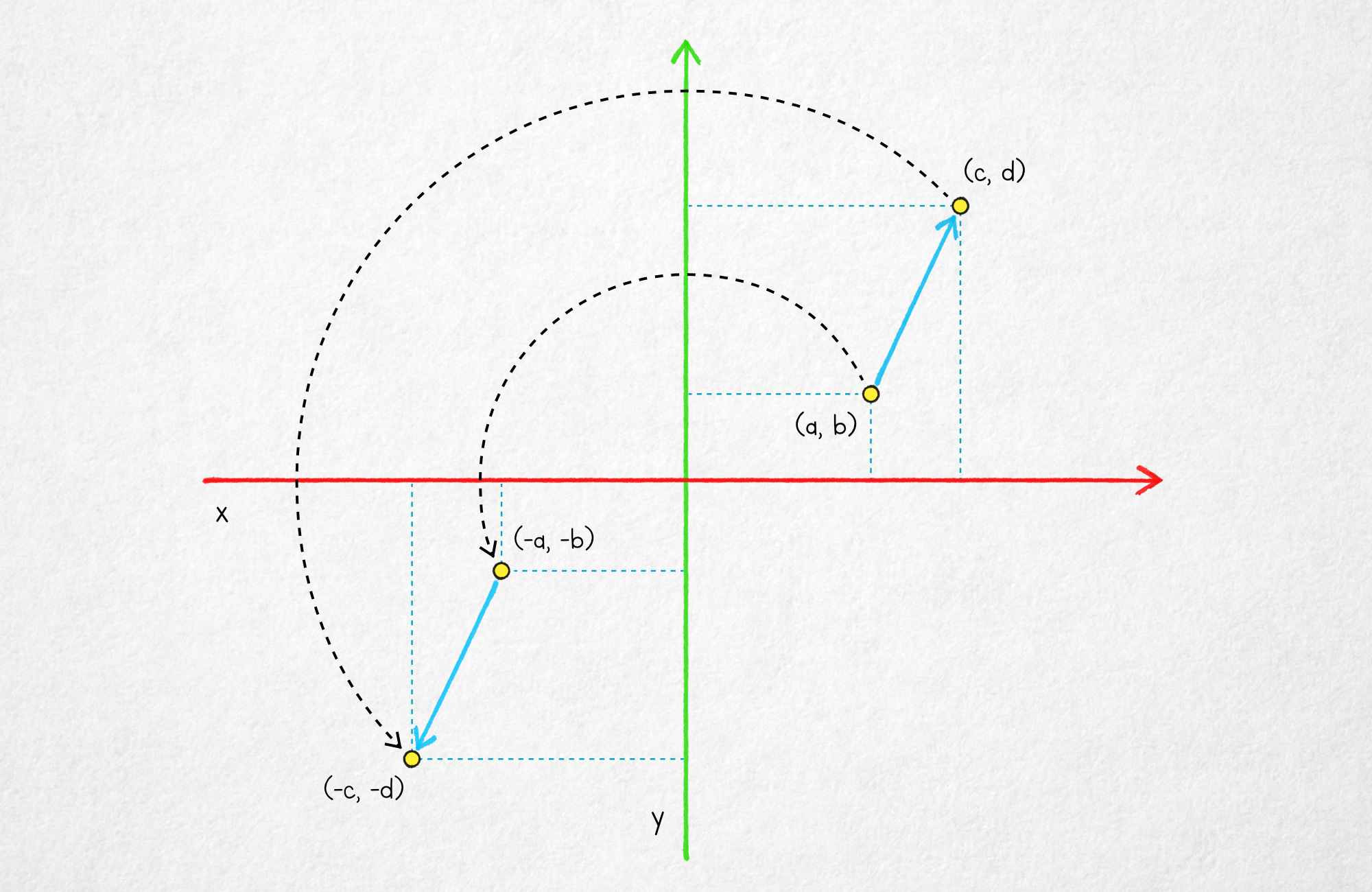
The sign-flipping operation is equivalent to multiplication by -1. Changing the magnitude of the negative multiplier doesn’t result in a different rotation angle; it’s the “negative unit" itself (-1) that appears to be doing the hard work. If we want to achieve a rotation by 360°, we need to multiply the coordinates by -1 twice; the pattern extends in a pretty obvious way:
This leads to a peculiar realization: it would appear that to achieve rotations of less than 180°, we could raise -1 to a fractional power. In particular, to obtain 90°, we seemingly need an exponent halfway between (-1)0 and (-1)1. In other words, we need to multiply the coordinates by (-1)½. This multiplier, known as i, can be also written as √(-1).
The number i is not a real. That’s not to say that it doesn’t exist; it just isn’t a member of the set of real numbers, ℝ. Because multiplication by i represents rotation by 90°, the construct lets us represent the coordinates of any point (x, y) as a single compound (“complex”) number:
The first part corresponds to the distance along the horizontal axis. The second (i-coupled) value is a number that’s evidently “rotated” by 90° — i.e., it’s cast from the horizontal axis onto the vertical one.
This might sound unhinged, but the result is a coherent model of 2D geometry; standard algebra extends to this i-containing realm in a pretty straightforward way. For the most part, you just work on the two halves of a complex number separately, just keeping in mind that i · i = -1.
With the z = x + iy construction in tow, let’s go back to the earlier method of rotating a point that lies on the horizontal axis at a distance l. Again, for some chosen rotation angle α, the new coordinates are:
Nothing stops us from combining these coordinates into a single complex number z that represents the x and y coordinates of the rotated point:
Equivalently, as discussed earlier, we can express rotation by m · 90° without trigonometric functions. We do this by multiplying the starting x-axis coordinate l by the correct power of i:
The equations describe the same thing, but in the first case, the angle of rotation (α) is conventionally expressed in radians, so a full 360° turn is achieved when α = 2π. In the second variant of the formula, the angle is measured in 90° increments, so a full rotation is m = 4. To reconcile these equations, we need to toss in the appropriate scaling factor. If we do it on the im side to settle on radians, we can write the following:
This can be further simplified by choosing l = 1, essentially building a model of a point moving along a unit circle with a radius of one:
This equation is already in the same ballpark as Euler’s formula, but we’re not quite done yet.
Imaginary bases and exponents
In the realm of real numbers, exponentiation that uses some base greater than 1 can be easily rewritten in another base greater than 1. We do this by tossing in an appropriate scaling factor in the exponent. For example, the following equality should be pretty clear-cut:
The scaling factor is always just the logarithm of the old base in the new base: log2(8) = 3.
It’s a related property of exponentiation that na · nb is the same as na+b. The second form tells us that if we choose b = -a, the result will be n0 = 1. But from the first form, we know that this can happen only if n-a perfectly “undoes” na, which means that it must produce a matching number of reciprocal terms. In other words, n-a = (1/n)a.
Given this observation, it should be clear that if we have a positive exponent base n greater than one, we can switch to the matching positive base less than one — 1/n — just by flipping the sign of the exponent. We can also combine this with the earlier technique for a bit more latitude:
But what if we add imaginary numbers to the mix? Well, we already know how to move between base i and base -1! By definition, i = (-1)½, so it follows that:
The right-hand scaling factor for this conversion ½. In other words, log-1(i) = ½ — and if we want to move in the other direction, logi(-1) = 2.
In the same vein, there exists a logarithm that gives us the appropriate scaling factor for a move from base i to positive 10:
The value of log10(i) can’t be a real number because if we assume x = 2, we’d end up with a contradiction: -1 on the left and some positive number on the right. That said, imaginary-number solutions seem like an idea we could entertain, with strong parallels to how using a negative exponent allowed us to hop between two disjoint types of positive bases.
And indeed, this leap of faith produces a coherent algebra in which the value of log10(i) works out to roughly 0.682·i; we’ll talk about how to calculate it in a while, but for now, the number is unimportant. The key point is just that if the conversion is possible — if log10(i) exists at all — there must be an equivalence between the two notations: ix and 10<some imaginary constant>·x. We know that the first one represents a rotation in a two-dimensional space. It follows that the second form does the same thing.
♫ You spin me ‘round (like a record)
Before the segue into the properties of exponentiation, we established the following formula that equated two methods of rotating a point:
On the left side of the equation, we needed to toss in a 2/π scaling factor to convert from radians to 90° increments. It would be nice to switch to a different, real-number base n that naturally has the same rotation speed as the cos + sin expression. This would let us simplify the formula to:
The cos + sin expression is drawing a circle with a radius of 1, completing one rotation every 2π radians. The circumference of the unit circle is 2π, so there is a 1:1 correspondence between the increment of the parameter of the expression (α) and the distance traveled by the rotated point.
Again, we’d like to match that speed on the left side of the equation by choosing n such that there is a similar 1:1 relation between the increment of α and the distance traveled by niα.
In the domain of real numbers, there is a well-known real base for which there is a 1:1 correspondence between the increment of the exponent and the increment of nx in the vicinity of x = 0. It is, by definition, the mathematical constant e. If you’re unfamiliar with this property, it’s easy to show it numerically; if we choose a small Δx = 0.0001 and calculate the rate of change near x = 0, we get:
We can also illustrate this on the plot of y = ex. The slope of the resulting curve is 45° near x = 0, suggesting that the function briefly behaves the same as y = x:
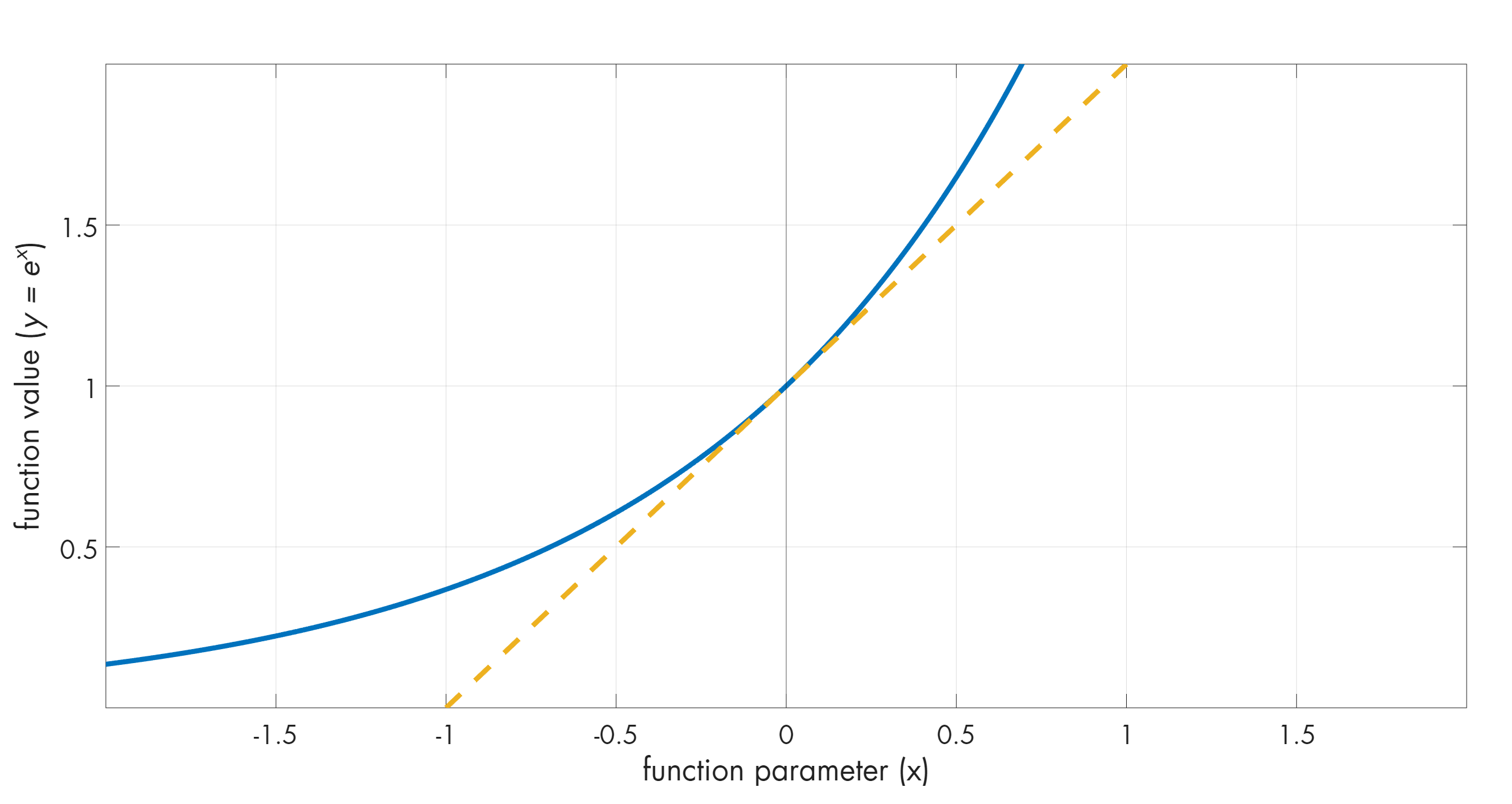
In the reals, the rate of change of ex increases in as we move further into positive values; that’s the nature of exponential growth. But in the realm of complex numbers, we have already asserted that a positive real raised to an imaginary power must result in constant-speed rotation, not runaway growth. We must conclude that the rate of change is dialed in solely by the real part of the exponent. This value is always zero in the formula we’re trying to build, locking the rate at 1:1.
This means that the scaling-factor-free solution we’re looking for is just:
As an important aside, the observation also gives us the value of loge(i), aka ln(i). Per the earlier discussion, switching from i to base e entails multiplying the exponent by loge(i). In this instance, the multiplication evidently cancels out the 2/π factor associated with the original base, so ln(i) must be π/2 · i, or about 1.571 · i.
The knowledge of ln(i) is enough to find positive-base logarithms of other imaginary numbers, too. For example, a while back, I remarked that log10(i) — the scaling factor needed to move from base i to base 10 — works out to roughly 0.682·i. To calculate this, we just need to tap into the basic property of logarithms that logb(a) = ln(a) / ln(b). Since we know the value ln(i), the only missing part is the vanilla, real-number logarithm of 10, which is about 2.303:
That’s it. Again, it’s not a real proof: the argument contains a couple of small appeals to intuition. That said, I like this chain of thought better than the usual explanations found on the internet.
As to why all these constants come together, the basic answer is that complex numbers are a two-dimensional geometry — and that radians, i, e, and π describe similar things.
👉 For more articles about math, visit this page. In particular, you might enjoy:


I write well-researched, original articles about geek culture, electronic circuit design, algorithms, and more. If you like the content, please subscribe.
One of my favorite Seinfeld standup jokes...